
Praise for Dress Codes
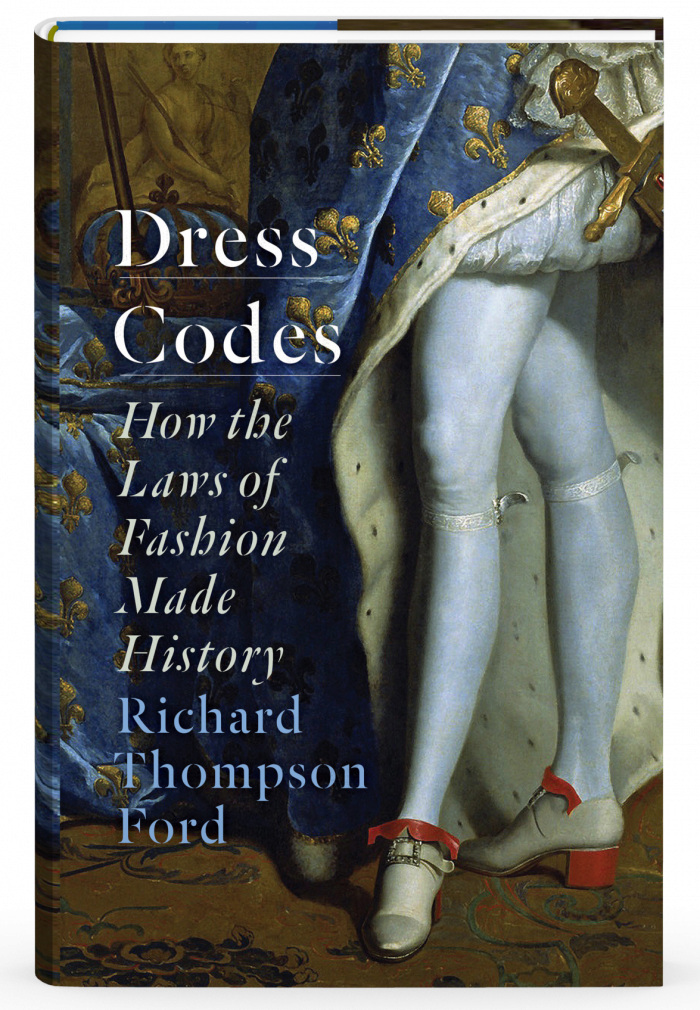
I think that Dress Codes is long overdue. Clothing is at the heart of culture…. We should all, as Richard Thompson Ford does so magnificently within this book, be taking fashion much more seriously.
– Ruth Goodman, Historian and Author of How to be a Tudor and How to be a Victorian
Dress Codes explores how for centuries fashion has marked a pathway for personal liberation and social critique even when it sought to reinforce class, race, and gender hierarchies. From nuns’ habits to flappers’ fringe to burkinis and hijabs, from Joan of Arc’s armor to Martin Luther King’s Sunday best, Richard Thompson Ford reveals a history of individual imagination capable of outwitting and recasting even the strictest rules. Ford’s writing is sharp, witty, and brilliant, with the elegance and craft of a bespoke suit.
– Daniel Sharfstein, Vanderbilt University, author of Thunder in the Mountains: Chief Joseph, Oliver Otis Howard, and the Nez Perce War
In Dress Codes, Ford has created a thorough and well-thought-out history of fashion from a legal and societal perspective. Whether exploring cultural appropriation, praising Ruth Bader Ginsburg’s lace neckwear or cautioning social media users that “every triumph or crime of fashion lives on in a digital archive,” the author is knowledgeable and passionate about his topic. “A dress code can be the Rosetta Stone to decode the meaning of attire,” he writes. Readers will come away with a new understanding of—and critical eye for—what we wear and why.
– Linda Castellitto – Book Page
[Ford’s] discussion embraces a vast body of knowledge…he’s an assured, genial narrator. He has an acute eye for detail, too. We eagerly follow his gaze from the well-dressed young men and women who sat in at lunch counters during the civil rights era to the Black Panthers’ “quasi-military style”…. Particularly relevant are [his] observations on how formal dress codes tend to target the least powerful – women, minorities, the poor…. For the clotheshorse and the jeans-clad alike, a lucid, entertaining exploration of how and why we dress as we do.
– Kirkus Reviews (starred review)
His engaging text provides ample historical and social context and is sprinkled with period quotes, cartoons, photos, and advertisements. Whether addressing codpieces, Ruth Bader Ginsberg’s lace collars, dreadlocks in the workplace, or pandemic curbside cocktail party attire, Ford’s writing is fresh, informative, and thoroughly enjoyable.
– Booklist
An intriguing history of formal and informal rules governing what people wear….[Ford] makes a convincing case that dress codes reveal much about the social order and the pursuit of individual liberty. This jam-packed history casts its subject in a new light.
– Publisher’s Weekly
Ford builds a case familiar to anyone who’s used a pair of shoes or a skirt as an act of rebellion—or who’s carefully selected a wardrobe to help themselves blend in. Fashion is both strategy and self-expression. It reflects the values of the society and the people who live in it, existing where the two overlap and conflict. What could be more serious?
– Rachalle Hampton, Slate
Ford’s writing is steeped in extensive research and makes what could be a dull history lesson about fashion a deeply informative and entertaining study of why we dress the way we do, and what that tells us about class, sexuality and power.
– Tariro Mzezewa, New York Times Editor’s Choice
An entertaining read, Dress Codes shows how fashion can both reflect and shape society.
– The Economist Espresso
In a jam-packed, fact-filled survey, Mr. Ford skillfully examines how fashion, far from being mere frivolity, has shaped people’s lives from the 14th century to the present
– Moira Hodgson, Wall Street Journal
Find full review of Dress Codes in The New York Times, The Financial Times, The Washington Post, The Economist Espresso, The BBC, The New York Post, Slate, The Wall Street Journal, The Cut, and Fortune.
A revelatory exploration of fashion through the ages that asks what our clothing reveals about ourselves and our society.
Dress codes are as old as clothing itself. For centuries, clothing has been a wearable status symbol; fashion, a weapon in struggles for social change; and dress codes, a way to maintain political control. Merchants who dressed like princes and butchers’ wives wearing gem-encrusted crowns were public enemies in medieval societies structured by social hierarchy and defined by spectacle. In Tudor England, silk, velvet and fur were reserved for the nobility and ballooning pants called “trunk hose” could be considered a menace to good order. The Renaissance era Florentine patriarch Cosimo de Medici captured the power of fashion and dress codes when he remarked, “One can make a gentleman from two yards of red cloth.” Dress codes evolved along with the social and political ideals of the day, but they always reflected struggles for power and status. In the 1700s, South Carolina’s “Negro Act” made it illegal for Black people to dress “above their condition.” In the 1920s, the bobbed hair and form-fitting dresses worn by free-spirited flappers were banned in workplaces throughout the United States and in the 1940s the baggy zoot suits favored by Black and Latino men caused riots in cities from coast to coast.
Even in today’s more informal world, dress codes still determine what we wear, when we wear it—and what our clothing means. People lose their jobs for wearing braided hair, long fingernails, large earrings, beards and tattoos or refusing to wear a suit and tie or make-up and high heels. In some cities, wearing sagging pants is a crime. And even when there are no written rules, implicit dress codes still influence opportunities and social mobility. Silicon Valley CEOs wear t-shirts and flip flops, setting the tone for an entire industry: women wearing fashionable dresses or high heels face ridicule in the tech world and some venture capitalists refuse to invest in any company run by someone wearing a suit.
In Dress Codes, law professor and cultural critic Richard Thompson Ford presents an insightful and entertaining history of the laws of fashion from the middle ages to the present day, a walk down history’s red carpet to uncover and examine the canons, mores and customs of clothing—rules that we often take for granted. After reading Dress Codes, you’ll never think of fashion as superficial again—and getting dressed will never be the same.
Richard Thompson Ford
 Richard Thompson Ford is Professor of Law at Stanford Law School. He writes about law, social and cultural issues and race relations and has written for The New York Times, The Washington Post, The San Francisco Chronicle, CNN and Slate. He is the author of the New York Times notable books The Race Card and Rights Gone Wrong: How Law Corrupts the Struggle for Equality. He has appeared on The Colbert Report, The Rachel Maddow Show, andThe Dylan Rattigan Show. He is a member of the American Law Institute and serves on the board of the Authors Guild Foundation. Quite to his surprise, he was one of 25 semi-finalists in Esquire magazine’s Best Dressed Real Man contest in 2009. He lives in San Francisco with his wife Marlene and two children, Cole and Ella.